No. 1
The Boomer Bubble
There is a sense, across the political spectrum, that something profound has shifted — that the long 20th century has finally come to an end. “The old order is not coming back,” Canadian Prime Minister Mark Carney told the assembled elites at Davos in January. “We are in the midst of a rupture, not a transition.”
But the postwar order Carney describes has ended several times already. It first ended in 1991, with the collapse of the Soviet Union. It ended again after 9/11, when national security and defense architecture was re-oriented around Islamic fundamentalism and the surveillance state — and again after the 2008 Great Financial Crisis, when China began to openly contest American supremacy. In 2016, even Trump’s first election didn’t quite presage the end of this order. So why now? What survived until now?
Within the macro context, people tend to diagnose our current predicament without bothering to explain it.1 Some invoke a byzantine historical determinism — six stages, eighteen measures, seventy-five-year cycles going back to the Renaissance — to argue that we are due for a reckoning. Others argue that the symptoms — our growing sovereign debt, a new interest rate regime, the coming great-power conflict with China — are in fact the cause.
These analyses gesture at something real without quite being able to name it. The last forty years have indeed been a uniquely stable period in American economic history. From the spendthrift capitalism of the Reagan years, to the tech bubble, to the housing bubble, to the ZIRP-era explosion of services during the low-tax-socialism of the 2010s, every response to every financial crisis rested on the same assumption: that the government would step in and protect major asset holders, no matter the cost. The bubbles kept coming, the bubbles kept popping, and yet nothing ever really changed.
The question is why. What made asset holders, suddenly, worth protecting at all costs? Boom and bust once ran roughshod across generations. The 1837 depression, the 1873 panic, the 1929 crash, even 1970s-era stagflation — all wiped out a substantial share of accumulated wealth. The possibility of ruin was once the cost of entry.
But beginning in 1987, and again in 2001, 2008, and 2020, whenever the system moved toward genuine price discovery, the playbook was always the same: cut rates, inject liquidity, protect asset holders. What looked like a series of bubbles — along with the cascading, escalating interventions they required — was always just one bubble. And what sustained that bubble wasn’t a fiscal or interest rate regime but a single constituency that is finally proving itself mortal.
What’s ending, really, is the long reign of the American Boomer.
I. The Boomer Compact
American Boomers — born 1946 to 1964, 76 million of them, 62% larger than the Silent Generation and 38% larger than Gen X — were an extraordinarily culturally synchronized generation, coming of age during the first and only broadcast monoculture. Their genesis lay in an unusually “closed” America, the result of restrictions that followed the early 20th century’s enormous immigration wave (in 1920, 13.2% of the American population was foreign-born; by 1970, that figure had fallen to 4.7%). Despite all the talk of Think Different™, of sexual liberation and racial progress and cultural diversity, they were the most homogeneous generation in American history.
They were also among the most economically compressed. Inequality peaked in the 1920s, just before the Great Depression, then fell sharply and stayed low through the 1950s and 1960s. College enrollment more than doubled between 1963 and 1973, as federal aid opened the gates for the growing suburban middle class. And Boomers’ education really could be paid for with part-time work. The median Boomer in 1970 covered four years of college tuition with just 985 hours of minimum wage (a Gen Z student needs around 6,200).
On July 1, 1971, the 26th Amendment lowered the voting age to 18, enfranchising 11 million young Americans with the stroke of a pen. Six weeks later, on August 15, Nixon closed the gold window and the fiat era was born. One act gave Boomers the political power they would wield for the next half century — the other created the monetary system that would make them rich.
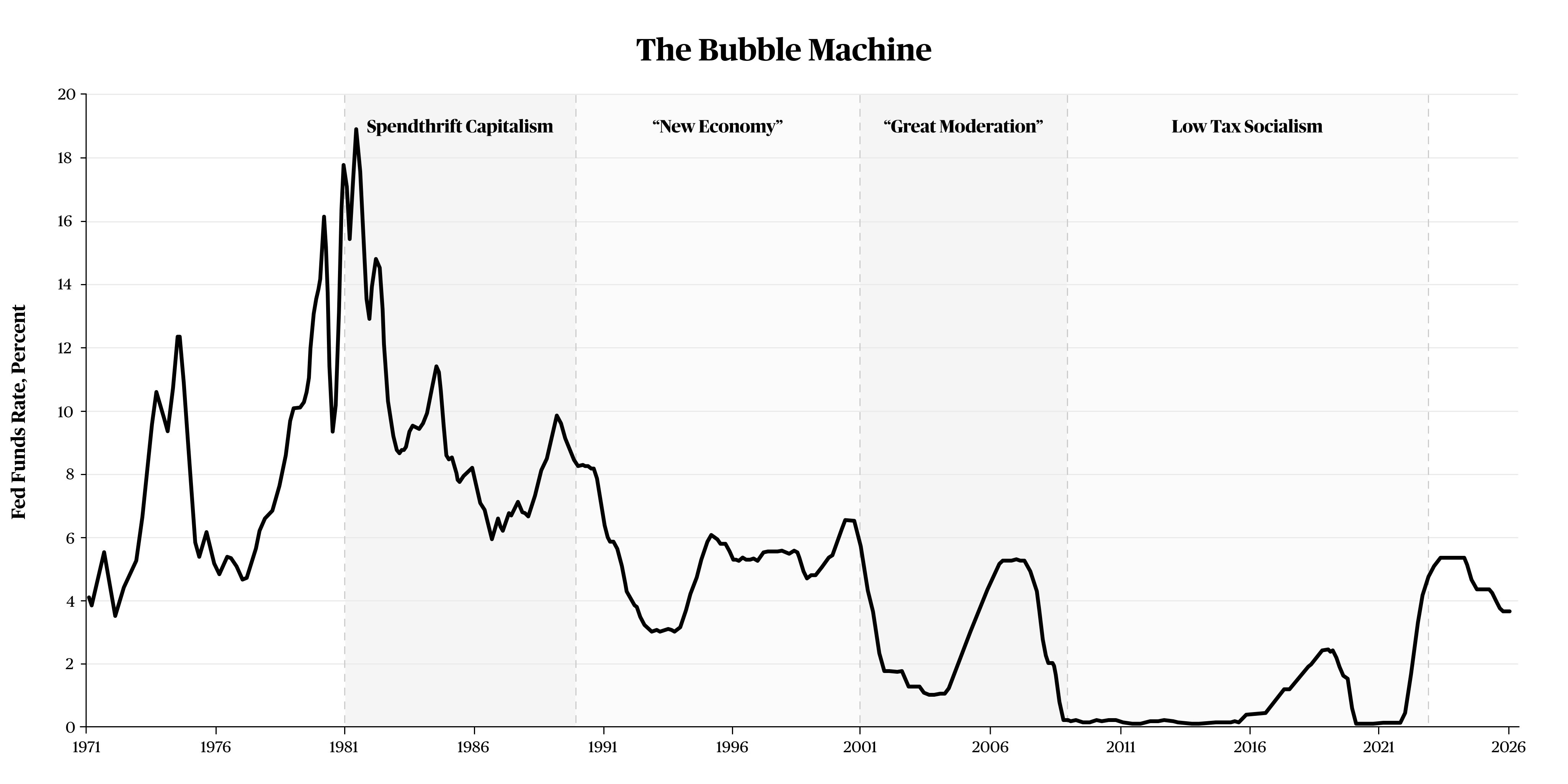
The 1970s proved as formative for the Boomers economically as the 1960s had been culturally. It was the last period in which interest rates reflected risk and asset prices corrected, in which the U.S. current account remained balanced, in which price discovery was still allowed. It was, unfortunately, also a misery: war, stagflation, gas lines. Volcker’s battle against inflation was brutal. By 1981, the fed funds rate reached 22%, and entire sectors of the American economy collapsed. In August 1982, the S&P stood at just 102.42.
It was, arguably, the most favorable entry point in the history of capital markets.
The architecture of the Boomer ascendancy comes into view. The Revenue Act of 1978 accidentally created the 401(k); the first plans launched in 1981, the same year the Economic Recovery Tax Act opened IRAs to all workers. Prop 13 (1978) and its imitators froze assessments just as decades of appreciation were beginning. If you had a 401(k) and a house by 1986, the next forty years would make you wealthy almost by default.
And so the Boomer Compact was born: a forty-year political-cultural settlement in which capital, the intelligentsia, and the median voter found their interests uniquely aligned. Prices would go up; money would stay cheap; entitlement spending would continue to expand; and asset holders would be bailed out, whatever the cost. After Black Monday in 1987, when the Fed put was born, Boomers held an estimated 18% of American household wealth. By 2003, when Bush’s post-tech-bubble capital-gains cuts passed the Senate 50-50, that share had more than doubled to 44%. In 2008, when TARP passed 74-25, the Boomers owned 53% of national wealth. Through no real fault of their own, they had become an immovable, illiquid asset class.
By March 2020, when COVID hit, the Boomers were at the apex of their power. They were, all at once, the system’s largest buyer, its median voter, and its largest asset holder. Every president since 1993 had been a Boomer.2 They owned 55% of household wealth and 57% of American stock. They held 56% of Congress and 70% of S&P 500 corner offices. They occupied 76% of the top 200 university presidencies.
There was, quite simply, no longer any domestic political constituency that opposed bailing them out. The Senate passed the CARES Act 96-0, providing $1,200 stimulus checks, $600 weekly unemployment supplements, and the Paycheck Protection Program, which eventually disbursed $800 billion in “loans,” $750 billion of which would never be repaid. The Fed balance sheet went from $4.2 trillion to $7.2 trillion in three months.
For one beautiful moment, we all got to be Boomers.3
II. Succession
No generation in history held so much power for so long. None had less of a plan for what comes next.
The 2010s was supposed to be the decade when the Boomers began to draw down their savings. Every actuarial model said so. But they wouldn’t leave. Instead of retiring, they kept accumulating: between 2010 and 2019, Boomer wealth nearly doubled, from $32 trillion to $60 trillion. By 2020, more than 30 million had crossed the traditional retirement threshold — and yet roughly half of all living Boomers, 35.7 million, remained in the labor force. Gen X and Millennials outnumbered Boomers more than two to one, yet held 30% less wealth.
What the actuarial tables predicted for the 2010s arrived instead, rather suddenly, in the mid-2020s. In just eleven weeks between February and April 2026, Disney, Adobe, and Apple all announced the exits of their Boomer CEOs. Boomers went from 67% of S&P 500 CEOs in 2021 to 35.3% as of this writing. In the House, where Boomers held a majority of seats during the pandemic, their share has fallen to 38.4%. The crucial difference between Trump I and Trump II is the dissolution of the Boomer containment layer: 72% of Cabinet-rank positions were filled by Boomers in 2017, compared to just 29% in 2025.
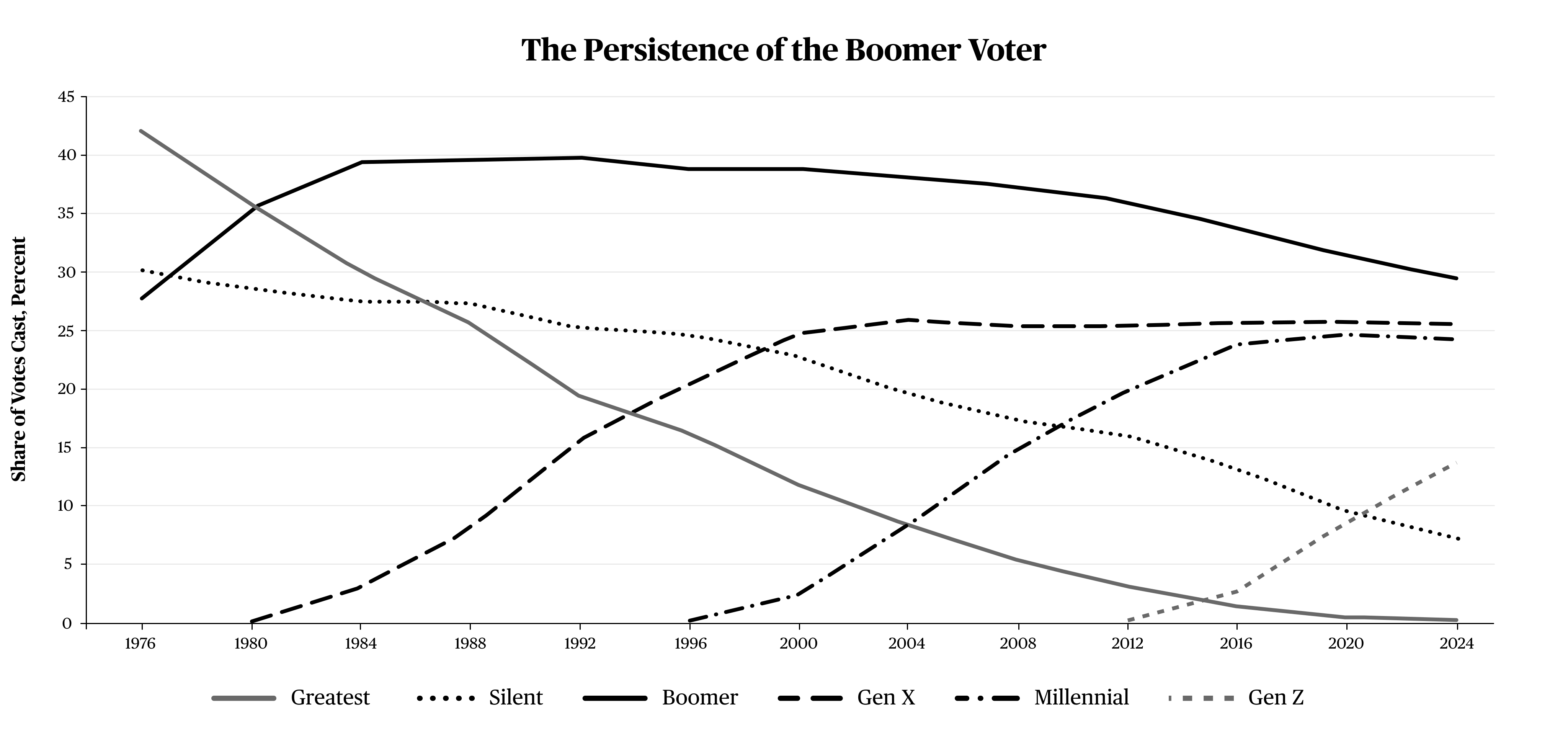
In 2025, roughly 11,400 Boomers turned 65 every single day, the largest cohort of Americans to cross the retirement threshold simultaneously. By 2029, there will be more Americans over 65 than children under 18. In 2032, for the first time since 1980, the largest voting bloc will no longer be Boomer. By 2033, Social Security won’t be able to pay full benefits. And by 2040, the worker-to-retiree ratio will fall to 2.3:1.
These impending reversals — all those demographic cliffs, $20 trillion in Boomer-held real estate becoming supply, $25 trillion in equity portfolios being sold off — are obvious and concerning. Required minimum distributions will soon turn the price-insensitive buyer into a price-insensitive seller. But the thinking around the so-called “silver tsunami” or the “gray wave” too often treats aging Boomers as a technical problem to be solved. Entitlements can be cut, the retirement age raised, immigration re-opened. A bull market can absorb a slow sell-off of Boomer portfolios; a healthy housing market can absorb a decades-long trickle of extra Boomer supply.4
What if the real problem is structural, institutional… theological?
The Boomers were true believers, the last generation to whom America unambiguously kept its promises. They insisted that politics was not zero-sum, never quite acknowledging that their interests and everyone else’s were not the same. From George W. Bush’s “ownership society” — every Boomer a king, with rates held near historic lows — to Obama’s Race to the Top, in which every American student would graduate “college- and career-ready,” the Boomer technocracy converged on the same guileless universalism. Globalization and free trade became a moral imperative. Dying factory towns could be reborn as tech hubs. Coal miners could be retrained as coders. Buy the dip — all corrections eventually reverse.
The shape of the American Empire was invisible to Boomers because they genuinely believed that what they wanted — rock and roll, jeans, free markets, liberal democracy, girls going to school — was what everyone wanted. In the Boomer imagination, the Color Revolutions in Eastern Europe and the Arab Spring were just delayed 1968s. Obama stayed in Afghanistan for eight years, long after the war was known to be a lost cause, not to protect hard American interests, but to protect Boomer soft power: all those NGOs, the whole apparatus of liberal nation-building. Even Donald Trump, who attacked Afghanistan as a “loser war,” couldn’t bring himself to end it.5 Whatever the conflict or partisan divide, idealistic Boomers could always summon the ghosts of World War Two to justify American military adventurism.
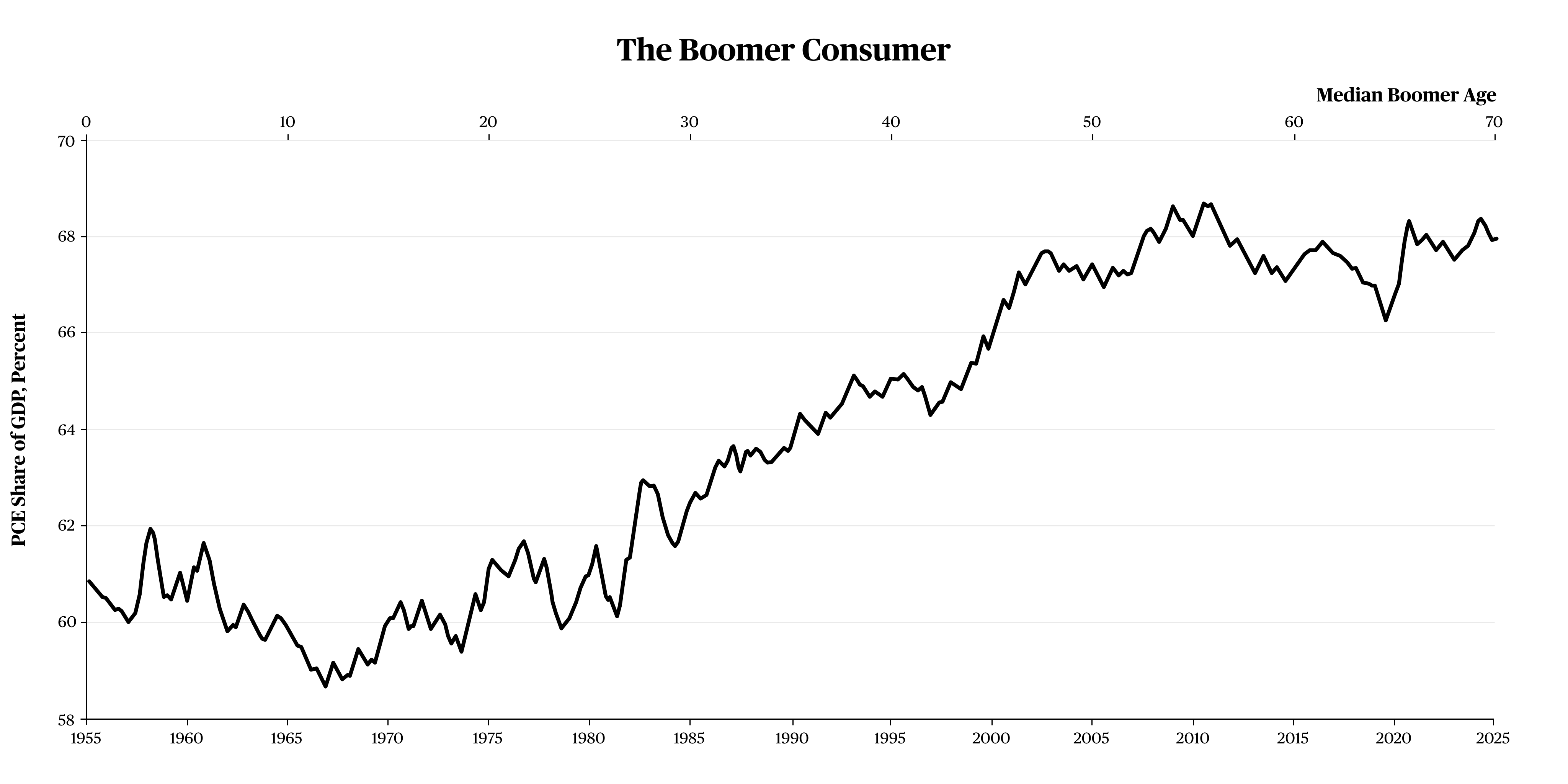
The generations that succeed them have little reason to keep the faith. In 1989, when most Boomers were still in their thirties, Americans under 40 held 12% of national wealth. By 2010, that share had cratered to 3.9%. A Boomer who put $1,000 into a 401(k) in 1990 held nearly $5,000 in 2010, even after the crash. A Gen Xer who put in the same $1,000 in 2000 had $909 a decade later. The median age of a first-time homebuyer recently hit 40, up from 29 in 1981. The income Gini rose from 0.40 in 1980 to 0.49 in 2024. And the fertility rate is now just 1.6 children per woman — the lowest in American history.
Some argue none of this much matters, that Gen X and Millennials will simply replace the Boomers among the asset-holding class. But just because money flows downward doesn’t mean it diffuses. The Great Wealth Transfer — the tens of trillions projected to move from older Americans to their heirs over the coming decades — will only further concentrate inequality. The top 10% of households will receive over half of all intergenerational transfers; the bottom half will get less than 10%. AI, by compounding the returns to capital, will accelerate the trend. Meanwhile, for the median middle-class decedent, wealth is depleted by end-of-life care.
Gen Z, for its part, understands intuitively it’s late to the party. The bubbles have already launched, deflated, launched again: the S&P is up 10x since the GFC; Bitcoin is up more than 100x since 2016. The fact that young people can buy 10x more televisions than their parents once could does not help them live adult lives. Even if steady accumulation still works — even if there are decades of S&P runway left and Nvidia becomes a $50 trillion company — this mindset itself, ipso facto, will reshape markets. A 26-year-old who believes he needs half a million dollars a year to feel financially successful isn’t buying $SPY or maxing out his Roth and waiting on 4.6% compound interest — he’s gambling.6
III. Post-Boomer Politics
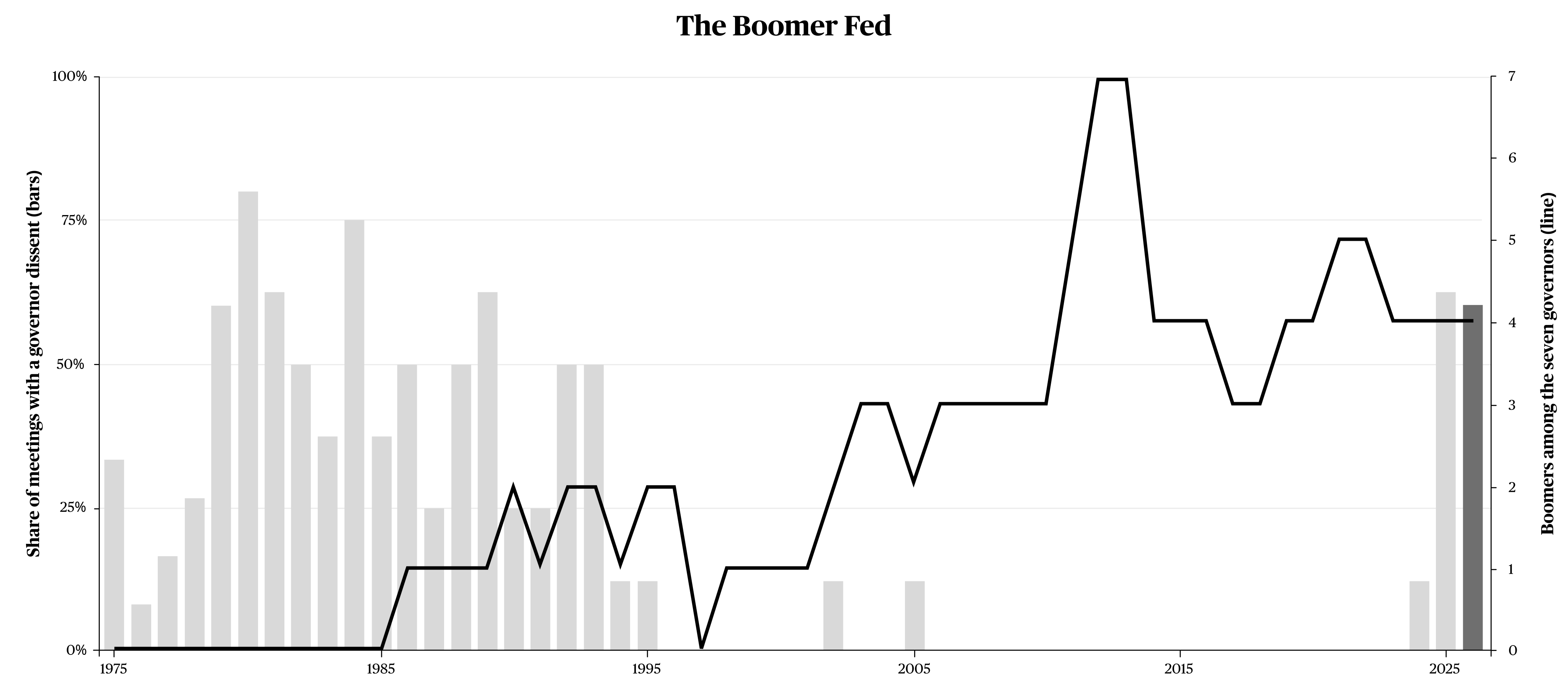
The Federal Reserve, before the Boomers got there, was a place where people argued constantly. In the 1980s, over 70% of FOMC meetings produced a dissent; a governor broke with the chairman at more than half of Volcker’s meetings. Six times the Board split against itself in a single sitting. Volcker actually lost a vote. Monetary policy was understood to be a political choice.
In 2006, Boomers became a majority of the seven governors — and suddenly the dissents stopped. Under Bernanke (b. 1953), Yellen (b. 1946), and Powell (b. 1953), across nineteen years and 148 votes, not a single Fed governor dissented.7 Through the housing bubble, the crash, ZIRP, a pandemic, and the worst inflation in forty years, the Board spoke with one voice. This wasn’t agreement about policy so much as agreement that there was no such thing as policy: the solution was always obvious, the interest always shared. The Boomer voter and the Boomer asset holder were the same person, which meant defending the market and defending the median voter was the same political act. What was good for the Boomers was good for America.
That alignment is gone: the new asset-holding class is too narrow, the new median voter has too little stake.8 If the 2010s was the era of low-tax-socialism, one shape of the next regime might be high-tax-low-tax-socialism: ever-rising taxes without any commensurate expansion of services. Spending balloons to keep up with entitlement programs while services remain sclerotic, with the exorbitant costs of Boomer aging as the catch-all justification for ever-higher taxes.
Last year’s Millennial socialist victories over establishment Boomer Democrats — Zohran Mamdani in New York and Katie Wilson in Seattle — were the canaries in the coal mine. This June, Democratic primary voters retired Adriano Espaillat (b. 1954), chairman of the Congressional Hispanic Caucus, in favor of a 32-year-old DSA organizer, and ended Colorado Representative Diana DeGette’s (b. 1957) fifteen-term career, electing Melat Kiros (b. 1997) in her stead. In November, Nithya Raman (b. 1981) appears to be on track to do the same to Karen Bass (b. 1953) in Los Angeles.
The class divide Mamdani and his successors ran on is, at its core, a generational one. The Boomers rallied around Andrew Cuomo (b. 1957) — he won voters 65 and older by 19 points — but they no longer had the political muscle to deliver. Inequality was an acute issue, especially among Mamdani’s base of downwardly mobile Millennial and Gen Z college grads (whose political consciousness, even after they eventually inherit their Boomer parents’ estates, will still be marked by the material conditions of their early and middle adulthood). We have gone from the fantasy of George W. Bush’s “ownership society,” in which homeownership and asset accumulation were universal aspirations, to one in which homeownership and asset appreciation are the problem.
As the Boomer Compact slowly dies — each coming election cycle will include fewer and fewer Boomer voters — the political distribution widens. Policy, at least on the left, will increasingly be made without regard to capital response. Under Boomer leadership, taxes were disguised, means-tested, smuggled in under cover of fiscal responsibility. California’s billionaire tax referendum — along with similar proposals in New York, Massachusetts, and Washington — presages something new: the point isn’t to build a road or balance a budget, but to punish and redistribute.9
The issue — unimaginable to establishment Democrats just a decade ago — will soon be nationalized as post-Boomer politicians (Ro Khanna, b. 1976; Gavin Newsom, b. 1967) seize the mantle. Candidates at the 2028 Democratic debates will no doubt attempt to outdo one another in their zeal for a federal wealth tax. It’s a potent issue: in 2025 the top 1% of U.S. households held 31.7% of the country’s wealth, the highest share since the Federal Reserve began tracking in 1989. A wealth tax is one way to bring that number down. So is a crash in which asset holders lose their shirts.
The logic of the Boomer Compact is suddenly being called into question. As the left goes post-asset-holder, the right has stopped pretending the median voter owns anything at all. Social Security and Medicare survived forty years of Republican attacks because Boomer voters made them the third rail of American politics, and Trump wouldn’t dare touch them. Sacrificing fiscal discipline in exchange for Boomer votes is a luxury that will not be afforded to his successors.
We are returning to a politics the Boomers suppressed but never quite defeated. The volatility of the 1970s is, in many respects, the economic reality we’ve spent decades postponing. Both Vance and Mamdani recognize, in a way the Boomers never had to, the zero-sum nature of political conflict: Vance says globalization costs American workers their jobs; Mamdani says the rent is too high because landlords are profiteering. Who pays, and for what, becomes the central question.
IV. Post-Boomer Markets
That the forty-year bull market in bonds should break the channel trend, just as the Boomers exit stage left, is not a coincidence. The structural forces that led to low rates — a global labor surplus that depressed wages, a savings glut that suppressed yields — were embraced by a demographic that would never have to experience the acute inequality caused by the constantly re-inflating asset bubble. The 1981-2020 bond market was the Boomer Compact’s most literal expression: a continuous bet on the present, on themselves, on the promise that tomorrow would inevitably resemble today.
That tomorrow is no longer legible. As the population pyramid inverts and the AI buildout accelerates, both labor and capital will become more scarce. Reduced immigration and deglobalization will further compound inflationary pressures. And the shift to a higher-velocity economy means Boomer savings, entitlement spending, and corporate earnings — accumulated over decades on electronic balance sheets — will be funneled back into the world of atoms.
Positive real rates will be the superstructure of the post-Boomer financial world.
Some argue that 5-6% is a stable range for the nominal rate. But the long end is under unrelenting pressure from a compounding deficit as Boomer entitlements continue to grow. If the Fed cuts into the AI buildout, it risks reigniting inflation and another asset boom just as inequality is at peak political salience. And if the Fed is too hawkish, it risks a shock to housing and equities, unplugging the twin Boomer engines of American economic confidence and consumption. The policy apparatus is stranded in no man’s land, praying AI is disinflationary enough to offset the structural inflation of the post-Boomer world, but not so disinflationary as to leave us all dead.
As their reign comes to an end, the Boomers’ preferred policy outcome is almost comically modest: hold rates and keep portfolios intact and inflation in check, while kicking the can down the road one final time. But the unanimity that characterized the ancien régime has fractured, and there’s no intergenerational coalition in sight. Unlucky Gen Xers, who watched the Boomers compound through the 1990s while their own returns went sideways in the 2000s, would love another rate cut and a melt-up before they cash out. Gen Z, which arrived after the doors closed, wants to burn it all down: steep rate hikes, 1982 again, and a grand reset that may yet turn a generation of nihilists into believers. And Millennials, half stuck in too-expensive houses, the other half hoping for a deus ex machina so they can get off the rental treadmill, don’t even know what they want.
Already the seams are showing. After nineteen years of placid unanimity, the Fed is fighting again: nine of the last sixteen meetings have produced a dissent, including the first double-governor dissent since 1993; the President tried for a year to remove a sitting governor; and Kevin Warsh (b. 1970) has spent his opening months as chair withdrawing forward guidance and letting markets reprice. “I asked for a good family fight, and I got one,” he said in July, after three regional presidents voted to raise rates against his recommendation to hold. Monetary policy is reverting to what it was before the Boomers arrived: contingent, contestable, political. The consensus is gone; volatility has returned.
The market no longer believes the Fed can do everything — and more importantly, the Fed no longer believes it, either. As long as suppressing rates and expanding the balance sheet carried no political cost, the bond vigilantes didn’t have a chance against the bazooka of Boomer QE. But cutting rates is now seen — by both left and right — as a transfer to a minority of asset holders, paid for in inflation by everyone else. And the foreign governments that were once evergreen, price-insensitive buyers have been replaced by private investors who demand real return for holding the digital fiction that U.S. Treasuries have become. The flight into hard assets and commodities is a harbinger of the post-Boomer world.
Because there’s nowhere else to go. The United States, which for decades insisted its interests and everyone else’s were one and the same, really was the Boomer among the nations: the world’s largest buyer and asset holder, extending its bull run past every plausible sell-by date.10 Every decade heralded a monetary successor — the yen, the euro, the renminbi, even Bitcoin — and none came close. Today America is a technology powerhouse, an energy powerhouse, the largest economy on earth, so far ahead no one seriously argues that a shrinking China will surpass it anymore. There is nothing after America: no rising power, no inheritor, nothing.
It’s 2032, and President Vance, or Newsom, or Rubio, or AOC, is watching markets crash in real time. The S&P is down 25%. The housing market is wobbling. Retirees are glued to whatever remains of CNN and CNBC and Fox News as their 401(k)s evaporate.
The Left wants to use the crisis to seize and redistribute; the Right, meanwhile, waffles on a painful restructuring of a sclerotic economy. The only consensus is that there is no consensus. Asset holders are no longer the majority constituency, which means all options are on the table. No one exactly wants the system to fail, but no one wants the status quo ante either.
For decades, there was always a Boomer who knew what to do. Clinton called Summers; Bush called Paulson; Obama called Geithner; Trump would put the entire geriatric membership of Mar-a-Lago on speakerphone. Democrat or Republican, they always said the same thing: cut rates, inject liquidity, protect asset holders. This time, there’s no one to call.
The put as we know it dies with the Boomers — and, with it, the Bubble finally bursts.
V. Coda
It is hard, even now, to imagine the world without them.
For forty years nothing seemed to change — 1980 to 2020 reads, in retrospect, like one long continuous present. Regular people once thought regularly about the future, and intuited what it might look like. There were those in 1960 who foresaw the Internet, robotics, even artificial intelligence. A college graduate in 1985 could sketch a reasonable path through adulthood. A policymaker in 1995 could very plausibly imagine the world of 2005.
And yet forecasting 2050, or even 2035, feels the way the 20th century must have felt from inside the 19th. Partly it’s AI and the pace of technological change: we can envision autonomous delivery and combat drones and paperclip-maximizing superintelligences, but can’t quite decide what any of it will mean.11 The fog, however, predates AI. The 2010s-era debates over secular stagnation, the failures to foresee Brexit and Trump, all spoke to a growing inability to think about political and economic life in the medium term.
Because the truth is: we’ve been unable to imagine a future without them.
The Boomer got to be the last interesting professor, the last up-from-the-stockroom CEO, the last accidental politician. They have always acted as if the world ends with them. The paradox is they may be right — and yet almost nothing is priced as if they are.
Notes
- 1. Zoltan Pozsar dates the rupture to March 2022 and the seizure of Russian reserves. In February 2026, Ray Dalio declared we had entered Stage 6, the “period of great disorder.” Howard Marks calls it a “sea change” in rates.
- 2. As the Boomers aged, they aged the institutions with them. In 1981, the year the first two Boomers entered the Senate, the chamber’s median age was 51.7. Today, with 62 Boomers still in the Senate, the median age has ballooned to 66.
- 3. But only for a moment. A 62-year-old Boomer homeowner with a small business and a retirement portfolio received $3,200 in stimulus checks, a $69,000 forgiven PPP loan, $90,000 in home equity appreciation, and his share of $20–22 trillion in stock market gains. A 28-year-old renter got $3,200. And then inflation hit — 9% CPI, 7% mortgage rates — and took that 28-year-old’s $3,200 right back.
- 4. Japan aged first, and its elderly never stopped being the median voter; the result was a compact that never broke and an economy that calcified. Japan’s 65+ share is nearly 30% today and climbing; America’s is just 18% — and isn’t projected to reach Japan’s current level until 2100.
- 5. Joe Biden, the only non-Boomer President since 1993, was also the only President who managed to withdraw American forces from Afghanistan. He did so over the objections of nearly every Boomer in his administration: Cabinet Secretaries Austin and Blinken, Generals Milley and McKenzie. Only Biden’s Gen X National Security Advisor, Jake Sullivan, supported withdrawal.
- 6. An Empower poll found that Gen Z says it needs $587,797 a year to feel “financially successful.” That’s nearly 6x what Boomers cited, more than 3x Millennials, and more than double Gen X’s $212K. Betterment recently found that 26% of Gen Z investors treat sports betting as an “ongoing component” of their financial plans.
- 7. Regional bank presidents sometimes dissented, a lone hawk or dove here or there, but this was mostly theater.
- 8. The first real test came in 2023, when Silicon Valley Bank and First Republic failed. The logic of 2008, that to rescue the mailman’s pension you had to rescue the banks, no longer applied. Depositors had no legal claim to anything beyond the FDIC-insured $250,000 but were made whole, because the state decided they still mattered. The shareholders did not.
- 9. A nearly 2,000-word New York Times op-ed advocating for California’s billionaire tax barely discussed revenue needs, instead focusing on extreme wealth, power, and fairness. Meanwhile the State Attorney General certified that the tax would likely lead to an “ongoing decrease in state income tax revenues.”
- 10. American Boomers built no great works — their proudest piece of physical infrastructure may be the Denver International Airport — and yet, improvising as they went, they built a society that dominates value across the world: 63 of the 100 most valuable public companies are now American.
- 11. Neither AI boosters nor AI skeptics can project even five years out: the boosters’ forecasts tend to dissolve around 2030, with tens of millions thrown out of work and the government effectively nationalizing the frontier labs; the skeptics, meanwhile, foresee an imminent capex crash. We suspect the middle path, in which the fog never quite lifts, is the world we must muddle through.